|
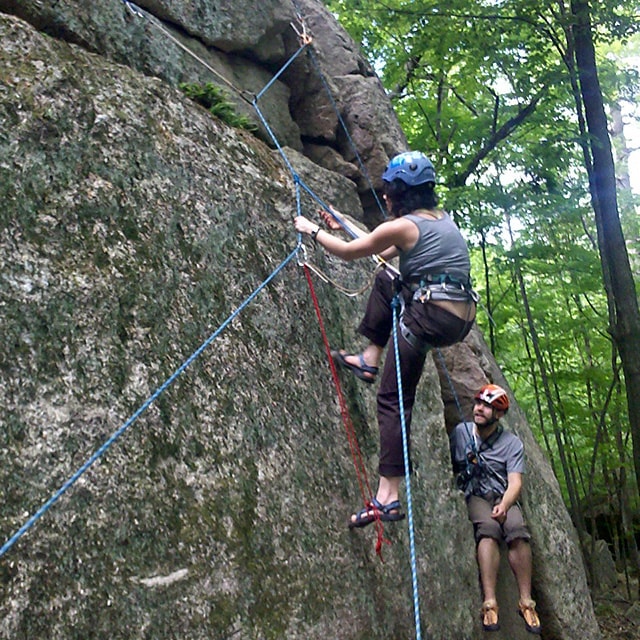
This course can be taken as one, two or three days, year round. We most often teach this course as rock rescue, but it can also be done in the winter in ice and mountaineering terrain. Depending on how much time you want to dedicate to the subject, we will plan the course accordingly. In one day we can cover a lot of the basics including the belay escape, rappelling or ascending to an injured partner, raising and lowering systems, load transfers, tandem rappels, country balance rappels, friction hitches, and of course the all important munter-mule hitch.
During the course we'll discuss several hypothetical worst case scenarios and then practice hands-on how you would extricate yourself and your partner from a serious accident in the vertical environment. Most of our guides are members of the Mountain Rescue Service, so in addition to teaching these valuable technical skills, we can also share first hand our stories from real life rescues we've conducted over the years.
The bottom line is that these hypothetical worst case scenarious are not actually all that far fetched. For example, you're belaying your partner up on a multi-pitch backcountry rock or ice climb when they are hit and knocked unconscious by rock or ice. Would you know what to do? If they were not breathing, do you have the knowledge and expertise to escape the belay and get to them within three minutes? Or how about if the leader falls on a traversing pitch and ends up badly hurt, dangling in space away from the wall? Do you know how to get to them? Are you solid with doing a series of load transfers with an unconscious partner who is dead weight on the rope?
My honest assessment as someone who regularly teaches these classes and as someone who spends a lot of time climbing is that the vast majority of climbers do not have these critically important skills.
Accidents do happen in climbing and if you are involved with this sport for long enough it is only a matter of time before an accident occurs to you or to someone climbing nearby. Do yourself a favor and invest in acquiring this knowledge before you actually need it.
As part of the course you'll receive photo-copies of essential systems and a suggested reading list so you can continue to study afterwards. Even after you learn the techniques, it's not a bad idea to practice them on a regular basis.
|